
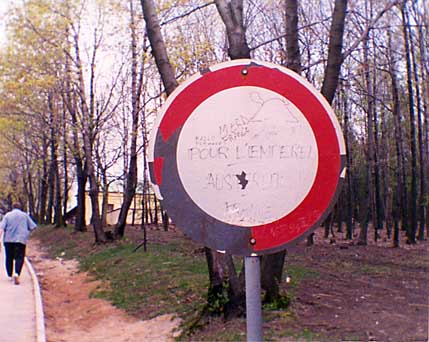
The battle of Austerlitz actually took place a little west of the village by that name. The single most dramatic moment was the French assault on the Pratzen heights. This picture, taken from the parking lot on the heights shows yours truly making my own assault. The sign was a hoot, with graffiti in multiple languages. Through the trees you can see the small museum where I bought this, and this and this. Only the second one was more than $5 and it cost the equivalent of two weeks pay for the average Czech at the time.
At the critical point of the battle on the heights, where the French attack hit the Russian Guard there was built a Peace Monument about 1913. The property where the battle took place is owned by the French government and oddly enough this ownership has been honored through all the changes that affected the Czech people.
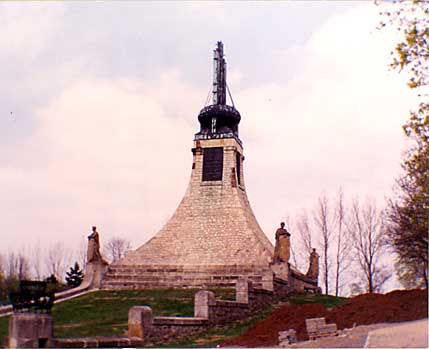
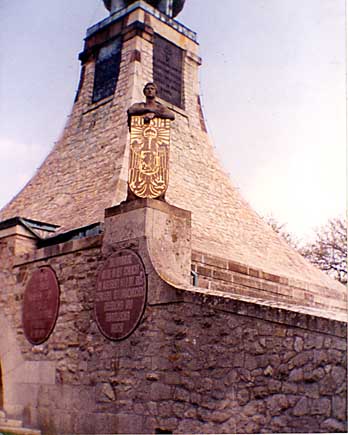
Each corner of the monument commemorates one of the combatant nations, with the fourth being the Czech combatants in Austrian service. This corner is the Russian one.
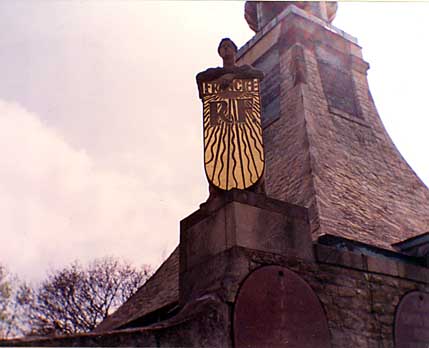
And here is the French corner.
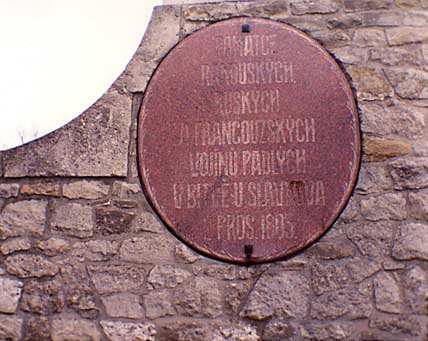
A plaque just below the French corner.
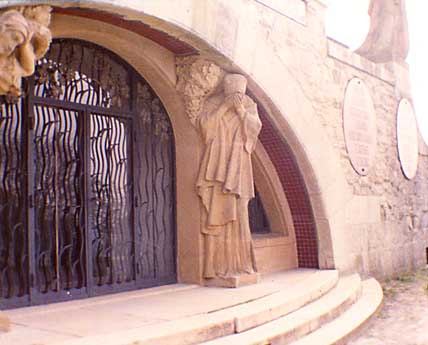
The monument is an ossuary, a place where the bones of people are buried. As such it is a tomb in fact. The crying woman is one of those images that best shows that war is not glorious, but a failure of diplomacy. A contemporary medal shows this as well.
Within this monument I felt it was sacrilegious to take pictures so I'll just tell you that it's quite plain, painted white. If you stand in any corner and whisper anyone in another corner can hear you quite clearly, even with many people talking in the middle of the room. When bones are discovered by the local farmers they are brought here and interred. As late as 1995 they were still finding them.
Within this monument I felt it was sacrilegious to take pictures so I'll just tell you that it's quite plain, painted white. If you stand in any corner and whisper anyone in another corner can hear you quite clearly, even with many people talking in the middle of the room. When bones are discovered by the local farmers they are brought here and interred. As late as 1995 they were still finding them.
A short page on the pheasantry in Sokolnitz.